Key Takeaways
Understanding technical specifications is essential for selecting the correct equipment for various tattooing techniques. These five points summarize the critical aspects of cartridge use:
- Proper needle gauge selection directly influences skin trauma and ink saturation speed.
- Safety membranes remain the primary defense against cross-contamination in modern pen machines.
- Quality control focuses on needle bar stability and the consistency of the plastic housing.
- Precision during application requires understanding the mechanical tension of internal membranes.
- Maintaining consistent voltage settings is vital to achieving expected pigment distribution.
Anatomy of professional tattoo cartridges
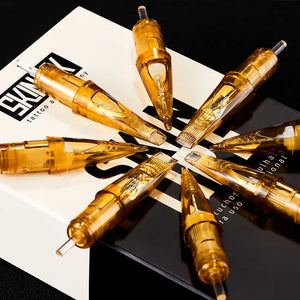
High-quality cartridges are built on a framework of medical-grade plastics and polished needle components. These tools translate the kinetic energy from Skin Ink USA machines into consistent skin penetration. Engineers prioritize the tolerance between the needle and the housing to ensure that lateral movement is kept to an absolute minimum.
Housing materials and industrial precision
The housing must withstand high-frequency oscillations without degrading or shedding particulate matter. Professional units utilize medical-grade polycarbonate or hardened plastic, which provides the rigidity necessary to maintain needle alignment under tension. When the housing is molded with exacting industrial precision, it prevents w obble and ensures the needle trajectory remains perfectly centered throughout the service.
Needle bar alignment and stabilization
Stabilization relies on a specific fit between the internal guide and the needle grouping. This alignment ensures that every puncture is uniform in depth and angle. Without this internal support, needles may drift, leading to blowout or inconsistent saturation, even when the artist maintains a stable hand speed during the tattooing procedure.
Internal membrane mechanics and tension control
The internal silicone membrane serves as a buffer that manages tension and prevents fluid backflow. High-quality membranes are designed to be soft enough to allow for a flexible needle hang, yet resilient enough to keep the drive bar sealed from contamination. Tension control is paramount for achieving consistent tool performance during long sessions, as the membrane must return to its neutral position cycle after cycle.
Needle configurations and their applications

Selecting the right configuration involves balancing the desired line quality with the specific area of the body being tattooed. Artists often rely on standardized gauge sizing to achieve varying results in skin depth and saturation density.
| Gauge Size | Diameter (mm) | Primary Application |
|---|---|---|
| #6 | 0.20 | Fine detail, micro-realism |
| #8 | 0.25 | Smooth gradients, soft shading |
| #10 | 0.30 | General lining, standard solid color |
| #12 | 0.35 | Bold lines, heavy color packing |
Liner needles for precision line work
Liners are designed for sharp, crisp edges in various artistic styles. The needle arrangement is tightly grouped, which directs the point toward a single target area without spreading the ink prematurely.
Shader needles for gradients and whip shading
Shader needles feature a looser grouping compared to liners, allowing artists to build tones gradually. Their structure supports techniques like whip shading or pendulum movements where creating soft transitions is necessary for depth.
Magnum needles for color packing and saturation
Magnums are essential for covering wide areas with color. Skin Ink Magnum Cartridges provide the surface area needed for efficient dispersion, making these tools ideal for large-scale realism or black-and-grey coverage without causing unnecessary skin trauma.
Bugpin versus standard gauge performance
Bugpin needles, typically ranging from 0.20mm to 0.25mm, offer finer precision but require careful handling to avoid accidental skin cutting. Artists must understand these trade-offs:
- Bugpins provide superior sharpness for delicate calligraphy and intricate line work.
- Standard gauge needles are more durable for aggressive packing or repetitive density work.
- Smaller pin diameters allow for higher pigment flow in fine-line aesthetic pieces.
- Heavier gauge tips offer the mechanical resistance some artists prefer for block outlines.
Artists usually adjust their voltage settings when switching between these styles to ensure optimal saturation.
Understanding safety membranes and hygiene standards
Safety protocols are the backbone of a successful studio, necessitating equipment that adheres to strict guidelines. Modern systems prevent the transmission of bodily fluids from the machine to the client and vice versa.
Function of the safety membrane in backflow prevention
The safety membrane acts as a physical barrier that restricts the migration of ink or blood into the motor housing. It must stay intact under high-speed operation, providing a complete vacuum that keeps internal machine components dry.
Sterilization protocols and packaging integrity
Each unit is sterilized using ethylene oxide (EO) gas to ensure the elimination of microorganisms. Packaging integrity describes the state of the individual blister seal; if the integrity is compromised, the sterility of the needle is no longer guaranteed, and the item must be discarded immediately.
FDA compliance and lead-free solder requirements
Compliance ensures that materials used in needle manufacturing, such as solder, are free from hazardous metals like lead. This is standard in modern manufacturing to protect both the operator and the recipient from chemical exposure.
Compatibility with modern machine systems

Compatibility across various universal-fit machine platforms ensures that artists retain the flexibility to swap configurations. Integration centers on the "click-in" mechanism which secures the housing to the grip system.
Cartridge integration for rotary pen machines
Rotary pens demand low-drag cartridges, as internal friction can cause the machine to exceed optimal power levels. The housing must fit snugly to prevent slippage or unexpected needle depth changes.
Adapting professional tattoo cartridges to coil machines
Coil machines require specific grips with integrated cartridge-receiving slots. These adaptors allow traditional systems to benefit from the hygienic advantages of current needle technology without sacrificing the hit properties typical of solenoid-driven machines.
Lock-in mechanisms and vibration reduction
A secure lock-in mechanism minimizes audible chatter and physical vibration. Reduced vibration is key to preventing hand fatigue, as the motor drive operates without unnecessary erratic movement.
Quality assessment for the working artist
Artists should perform routine visual inspections before each session to ensure that the tools are ready for application. This systematic approach includes checking for tip sharpness and membrane tension.
Identifying visual defects under magnification
Using a jeweler’s loupe or smartphone magnification, artists can check if the needle point shows signs of hook or burrs. Any physical deviation from the tip's straightness indicates a defect that could tear the skin.
Performance testing for ink flow consistency
Testing ink flow involves monitoring how well the needle tip draws and releases pigment. If the cartridge consistently holds ink and releases it in a predictable stream, the internal dynamics are functioning correctly.
Evaluating needle sharpness and skin trauma
Sharpness is directly measurable by the ease with which the needle enters the epidermis. A dull needle causes excessive dragging, leading to early bruising and extended healing times.
batch-to-batch consistency and manufacturing reliability
Reliability is proven when a user receives exactly the same performance from one box as they did from the last. Artists monitor whether tips vary in diameter or if membranes exhibit similar elastic resistance across multiple orders.
Selecting the right tool for the job
Choosing gear depends on understanding the unique demands of skin texture and the specific artistic goal. Every artist eventually develops a preference based on their personal technique and voltage modulation.
Matching cartridge specs to diverse skin types
Thinner skin on sensitive areas like the inner wrist requires lower voltages and finer gauge needles. Conversely, thicker, weathered skin usually benefits from larger diameter needles that can better penetrate the dermis.
Optimizing voltage and needle hang for consistent saturation
Needle hang is the amount of needle exposed beyond the tip. Increasing hang requires slightly higher voltage to compensate for the distance the needle travels inside the cartridge.
Troubleshooting common cartridge failures during service
Common issues often relate to ink buildup inside the tip, which creates drag on the motor. Troubleshooting involves ensuring the cartridge is seated correctly and that the ink viscosity matches the needle gauge.
Conclusion
Selecting the right tools is a foundational element of maintaining high artistic standards and hygiene. By focusing on membrane reliability, internal housing quality, and precise needle configurations, artists ensure that their work remains consistent and safe throughout every session.
Frequently Asked Questions
Do cartridge needles require different voltage settings than traditional setups?
Most modern rotary machines perform optimally at standard voltages, but artists often need to adjust current based on the specific resistance of the internal cartridge membrane.
How can I tell if a safety membrane has failed during a session?
Visible signs include ink accumulating inside the motor grip or a change in the resistance felt while the machine is running, often accompanied by a muffled sound.
Are larger diameter needles always better for color packing?
Not necessarily, as larger diameters cover more space but might cause more trauma, whereas smaller needles allow for more controlled layering in sensitive transitions.
What prevents ink from splashing inside the cartridge tip?
Proper interior tip geometry directs the pigment along the needle shaft without allowing it to pool near the exit, which reduces splashing and splatter.
Does the material used in the cartridge housing impact machine longevity?
Yes, high-quality medical-grade plastic prevents the accumulation of micro-particles that can wear down the motor bearings over extended periods.
Is it necessary to store cartridges in a climate-controlled environment?
Storing them in a temperate, dry area prevents the degradation of the membrane material and keeps the packaging seals from breaking down due to humidity.
Can cartridges be reused after cleaning in an ultrasonic bath?
No, cartridges are strictly single-use devices meant for disposal to ensure total sterility; attempting to clean them is dangerous and compromises safety.