Key Takeaways
Round liner tattoo needles are selected by grouping, diameter, taper, and the way the artist works the skin. The correct choice improves control, but it does not replace sound machine technique or safe practice.
- Tight groupings support crisp, narrow lines and small details.
- 0403, 0405, and 0407 commonly indicate fine-line configurations, while 04, 06, and 08 describe gauge or diameter conventions depending on the manufacturer.
- Needle count and diameter should be matched to line weight, pigment load, skin, and hand speed.
- Taper changes how quickly pigment enters the skin and how the point behaves during a stroke.
- Sterile, compatible, single-use equipment remains essential for professional tattooing and PMU work.
What round liner tattoo needles are designed to do
Round liner tattoo needles group their points in a circular formation so pigment can be deposited along a controlled path. They are primarily used for outlining, detail work, lettering, and selected forms of stippling. Their behavior depends on more than the word “liner”: count, gauge, taper, solder distance, and machine setup all affect the result. Skin Ink USA’s needle configuration guide provides a useful reference for comparing liners with shaders, flats, and magnums.
Needle grouping and soldering structure
A round liner is identified first by its count and arrangement. A 3RL has three points grouped closely around a center, while a 7RL has seven points and generally creates a broader mark when the gauge and taper are comparable. Soldering distance also matters: a tighter grouping keeps the points closer together, while a looser grouping can spread pigment across a softer, wider contact area.
Artists should read the full code rather than relying on count alone. A code such as 0403 may indicate a 0.4 mm, three-needle fine-line configuration; 0405 and 0407 follow the same basic naming logic in systems that use metric-style codes. Packaging conventions vary, so the manufacturer’s specification should take priority over assumptions.
How round liners differ from round shaders
Round liners are generally arranged for a more defined central contact, making them suitable for continuous lines. Round shaders use a circular grouping with more spacing between points, allowing pigment to spread more readily for soft lines, small fills, and controlled shading. The two configurations can look similar at a glance but behave differently once the needle meets the skin.
A liner is not automatically the better choice for every dark mark. For a small textured fill, a round shader may distribute pigment with less repeated passage; for a clean contour, a liner gives the artist a more predictable edge. The decision should follow the intended surface treatment.
Line consistency, pigment flow, and saturation
Consistent linework requires stable needle movement, adequate pigment flow, and a grouping that suits the artist’s hand speed. A small liner moved too slowly can overwork a narrow track, while a large liner moved too quickly may leave an under-saturated line. Stable needle control matters more than the nominal size printed on the package.
Membrane tension, cartridge housing, and needle alignment also influence how smoothly pigment reaches the point. Artists should assess whether a configuration starts cleanly, holds its depth, and maintains a steady deposit through the entire stroke rather than judging it only by the first pass.
Common tattoo styles that rely on round liners
Traditional and neo-traditional work often uses larger round liners for assertive contours, while fine-line, ornamental, micro-realism, and lettering work may call for smaller configurations. Dotwork and stippling can use a liner when the artist wants discrete, repeatable points. PMU specialists may also use fine configurations for delicate, controlled marks, subject to the procedure and applicable regulation.
For a broader technical comparison of cartridge anatomy, gauge, membrane behavior, and machine compatibility, artists can review this cartridge construction guide. It is especially helpful when a line looks inconsistent despite an apparently appropriate needle count.
How round liner configurations affect performance
Configuration changes the width, edge, saturation, and forgiveness of a stroke. “Tight,” “standard,” “loose,” and “bugpin” describe practical differences in point spacing or diameter, but naming can vary between manufacturers. An experienced artist tests each configuration on a suitable practice surface and then adjusts speed, voltage, and pressure for the client’s skin.

Tight round liners for precision and fine detail
Tight round liners keep the points close together and are suited to narrow contours, small lettering, and precise detail. They can produce a clean visual edge when the hand is steady and the skin is appropriately stretched. The trade-off is that a tight grouping gives the artist less room to disguise inconsistent depth or speed.
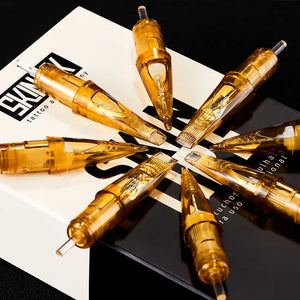
The Round Liner Cartridges from Skin Ink USA are documented as having needles grouped in a circular formation for sharp outlines, intricate details, and consistent lines. The product page also documents SUS 304 stainless steel and an advanced sealing system intended to prevent ink backflow; those are product specifications, not a substitute for studio hygiene protocols.
Standard round liners for versatile linework
Standard round liners are often the practical middle ground for everyday outlining. They can cover a wider range of line weights than very small configurations without becoming as forceful or pigment-heavy as a large liner. A 05 or 07 equivalent may be useful when the design needs a visible contour with moderate flexibility.
The artist should still compare the actual diameter, taper, and grouping rather than treating “standard” as a universal specification. Two cartridges with the same count may lay down different lines because their gauges and point alignment differ.
Loose round liners for softer edges and controlled shading
A loose round liner spaces its points farther apart, creating a less concentrated contact pattern. It can be useful for textured outlines, stippling, small areas of soft shading, and transitions where a hard contour would look too severe. It is not the same tool as a round shader, although the effects can overlap at the edge of their uses.
Because the points do not act as one dense unit, pigment distribution may appear lighter or more broken. The artist may need a slower, more deliberate pass, while avoiding repeated work that creates unnecessary irritation.
Bugpin round liners for dense pigment deposits
Bugpin liners use a smaller needle diameter, allowing several points to occupy a compact grouping. They are commonly chosen for fine detail and dense deposits where a standard-gauge grouping would appear too broad. Codes such as 0403, 0405, and 0407 are often discussed in fine-line work, but the exact meaning must be confirmed on the packaging.
Bugpins reward careful control. Their narrow points can enter the skin efficiently, yet a slow hand or excessive pressure can concentrate trauma in a small area. They should be selected for the design and the artist’s technique, not simply because the configuration is labeled fine line.
How to choose the right needle size
Needle size is a combination of count and diameter, not a single universal measurement. In some catalogs, 04 refers to a 0.4 mm gauge, while 06 and 08 refer to progressively larger diameters; other catalogs use different naming systems. Artists should compare the code, count, taper, and manufacturer specification before building a working set.
Small diameters for fine lines and microdetail
Small diameters are appropriate when the design calls for restrained line weight, tiny facial features, delicate textures, or compact ornamental details. A 0403 may be a logical starting point for a very narrow line, while 0405 or 0407 can provide more pigment contact without immediately moving to a broader standard gauge.
Fine-line artists should not confuse a smaller needle with a guaranteed finer healed result. Skin type, pigment, depth, stretch, and movement all affect how a line settles. Skin Ink USA’s Fine Line Cartridges are documented for ultra-fine lines, dotwork, intricate details, calligraphy, geometric tattoos, and micro-realism, with a universal fit for most tattoo machines.
Medium diameters for general-purpose outlining
Medium diameters, often represented by 06 in gauge terminology, provide a useful balance between definition and pigment delivery. They can suit general outlining, medium lettering, ornamental borders, and designs that need a visible but not heavy contour. A medium liner is often easier to control across changing curves than an extremely small configuration.
The correct choice depends on the finished line rather than the stencil alone. A line that appears narrow on a flat drawing may need more visual weight after placement, especially on areas that move or stretch.
Large diameters for bold lines and solid fills
Larger diameters, commonly associated with 08 in gauge terms, place more pigment across a broader contact area. They can support bold outlines and selected compact fills, although larger fills are usually better handled by shader or magnum configurations. A large round liner may be useful where a strong contour must remain clearly defined.
Artists should avoid forcing a large liner into a small, detailed design. Its efficiency in a broad stroke becomes a liability around tight corners, small lettering, or fragile textures.
Diameter, taper, and hand speed considerations
Needle diameter cannot be evaluated separately from taper and hand speed. A long taper may enter gradually and produce a finer-feeling line, while a short taper can deliver pigment more quickly and feel more assertive. The machine’s stroke and voltage then determine how much energy reaches the point.
A practical selection process can be kept simple:
- Define the intended healed line weight, not only the fresh appearance.
- Compare 04, 06, and 08 options within the same manufacturer’s system.
- Match the needle to the artist’s normal hand speed and machine stroke.
- Test saturation and skin response before committing to a long session.
The final choice should be recorded with the machine settings and client-skin observations. That record is more useful than treating a size code as a fixed promise.
Matching round liner tattoo needles to tattoo applications
Application determines whether precision, saturation, softness, or speed matters most. A professional artist may use several round liner sizes in one tattoo, changing configuration as the design moves from a major contour to a small texture. The cartridge should support the planned motion rather than dictate it.

Crisp outlines in traditional and neo-traditional work
Traditional and neo-traditional tattoos generally benefit from deliberate, readable contours. Medium or large standard round liners can create the visual authority these designs require, provided the artist maintains consistent depth and follows the curve without crowding the line. Tight liners remain useful for smaller interior details.
A strong outline does not come from needle size alone. Stretch, angle, pigment consistency, and a controlled return at corners all contribute to a clean result. The artist should choose the smallest configuration that still gives the design its intended weight.
Fine-line realism and delicate textures
Fine-line realism depends on restraint. Small bugpin configurations such as 0403, 0405, and 0407 can help place narrow marks, hair-like textures, and subtle contours, but they also expose every variation in hand speed. Longer tapers may feel more forgiving for gradual deposits, while shorter tapers can be useful when stronger saturation is needed.
The fine-line cartridge selection discusses size, configuration, taper, stability, and machine fit, including 0403, 0603, and 0803 examples. Those codes should be treated as specifications to compare, not as interchangeable labels across every cartridge range.
Lettering, geometric designs, and ornamental work
Lettering and geometric tattoos require repeatable width and accurate point placement. A tight liner can keep small characters legible, while a medium liner may give larger lettering enough visual density. For long geometric segments, a stable cartridge and consistent hand travel are usually more valuable than aggressive pigment loading.
PMU specialists should apply the same technical discipline while also following the scope of their procedure, local rules, and client-safety requirements. In regulated aesthetic settings, compliant clinic marketing is a separate concern, but it reinforces the need to distinguish documented practice from unsupported claims.
Dotwork, stippling, and controlled shading
Dotwork benefits from a configuration that creates consistent points without forcing the artist to overwork the skin. Tight liners can make compact dots, while loose liners can produce a softer, more varied distribution. The artist’s lift-off timing and machine motion often matter as much as the needle grouping.
For compact shaded areas, a round shader may be more efficient than repeatedly circling with a liner. The Round Shader Cartridges from Skin Ink USA are documented for well-pigmented fills, gradients, artistic textures, and soft organic lines, with compatibility described for universal-fit tattoo machines. That documented distinction helps prevent using a liner where a shader is the more suitable tool.
How taper and needle geometry change the result
Taper describes how quickly the needle point narrows toward its tip. Geometry affects entry, pigment release, line softness, and how much correction a stroke can tolerate. These variables are particularly visible in fine-line work, where a small change in point behavior can alter both the fresh mark and the healed appearance.
Short, medium, and long tapers
Short tapers reach their full diameter quickly, often producing a more immediate pigment deposit and a stronger-feeling stroke. Medium tapers provide a middle response. Long tapers narrow over a greater distance and may create a more gradual entry, which many artists find useful for fine lines, delicate textures, and controlled transitions.
No taper is inherently safer or more accurate. A long taper can still cause trauma when driven too deeply or too slowly, while a short taper can produce a clean line in a skilled hand. The correct selection follows the intended deposit and machine movement.
Needle point alignment and line accuracy
Point alignment determines whether all needles contact the skin evenly. Misalignment can create a split, fuzzy, or intermittently saturated line even when the nominal configuration is correct. Artists should inspect visible points and test the cartridge before beginning the client procedure.
Cartridge stability also matters during curves and direction changes. If the grouping shifts or vibrates, the artist may compensate with pressure, which can worsen both line quality and skin response.
Tip visibility and cartridge membrane design
A visible tip helps the artist judge placement, angle, and the distance between the needle and the stencil. Housing walls should provide visibility without compromising structural stability. Membrane design influences needle return and helps isolate the machine from pigment and bodily fluids.
Universal fit is useful only when the cartridge actually seats securely in the selected grip and machine. Artists should confirm fit rather than assuming that every cartridge standard behaves identically across every setup.
Balancing pigment flow with skin trauma
More pigment flow is not automatically better. Excessive flow can obscure the working area, while insufficient flow encourages repeated passes. The artist should seek a steady deposit that reaches the intended depth with the fewest necessary passes.
A useful operating principle is to change one variable at a time. If a line is too light, the artist can evaluate speed, voltage, taper, and pigment before increasing pressure. This preserves diagnostic clarity and helps limit unnecessary skin trauma.
How to select, set up, and use round liners safely
Safe use begins before the machine is switched on. The artist should verify the configuration, packaging, fit, and intended application, then prepare the station according to applicable local requirements. ANVISA requirements may apply in relevant jurisdictions, and studio procedures should follow the stricter applicable standard when regulations differ.
Choosing compatible cartridges or needle bars
Cartridge users should confirm that the unit seats correctly, advances smoothly, and maintains stable needle movement in the chosen grip. Many modern cartridges are designed around universal-fit systems, but “universal” does not remove the need for a physical fit check. Artists using needle bars should verify bar length, solder integrity, tube compatibility, and movement before client work.
The cartridge should be selected as a complete system: grouping, diameter, taper, tip visibility, membrane, and machine interface all matter. The Skin Ink offers a useful coverage reference for liners, shaders, bugpins, and other configurations.
Machine stroke, voltage, and hand-speed adjustments
Machine stroke affects how far the needle travels, while voltage influences cycling speed and available force. A longer stroke and faster hand can behave very differently from a short stroke and slower hand, even with the same liner. Artists should make small adjustments and observe the line rather than copying another artist’s settings.
A stable setup generally feels controlled rather than forceful. If the machine sounds strained, the needle skips, or the skin becomes increasingly irritated, the artist should stop and reassess instead of simply increasing voltage.
Proper needle depth and skin stretching
Needle depth should be sufficient for the intended deposit without driving unnecessarily deep. The artist controls this through machine give, hand pressure, angle, and the amount of needle exposed. Skin stretching should create a stable working plane while respecting the anatomy and elasticity of the area.
The same setup will not behave identically on every body site. Curved, thin, or highly mobile skin may require a lighter hand and slower evaluation. Client comfort and skin response remain active feedback during the procedure.
Conclusion
Round liner tattoo needles perform best when the artist treats count, gauge, taper, geometry, machine setup, and skin response as one connected system. Careful comparison of 0403, 0405, 0407, 04, 06, and 08 options helps establish a useful working range, while disciplined hygiene and single-use handling protect both artist and client.
Frequently Asked Questions
What is a round liner tattoo needle used for?
A round liner is primarily used for outlining, lettering, fine detail, ornamental work, and selected dotwork or stippling applications. The appropriate size depends on the intended line weight and technique.
What do 0403, 0405, and 0407 mean?
These codes commonly describe fine-line configurations in which 04 indicates an approximately 0.4 mm diameter and the final digits indicate needle count. Packaging specifications should always be checked because coding conventions can vary.
Is a 04 needle finer than a 06 or 08 needle?
In gauge systems where the numbers refer to diameter, 04 is smaller than 06 and 08. The actual result also depends on count, taper, soldering, hand speed, and machine settings.
What is the difference between a tight and loose round liner?
A tight round liner places its points closely together for a more concentrated line. A loose round liner spaces the points farther apart, which can produce softer edges, texture, or a less concentrated deposit.
Are bugpin round liners suitable for every tattoo?
No. Bugpin configurations can be useful for fine detail and dense small deposits, but they require careful control. They may be inefficient for broad fills and can overwork a small area if used with excessive pressure or slow movement.
Can round liners be used for shading?
They can be used for stippling, texture, and selected controlled shading effects. For broader soft shading or efficient fills, a round shader or magnum may be more appropriate.
How should tattoo needles be handled after opening?
Sterile needles and cartridges should be checked before opening, used for one client and one procedure, and discarded through the studio’s approved sharps process. A damaged or questionable package should never be used.