Key Takeaways
High precision tattoo needle cartridges are selected by specification, tested by behavior, and handled through a controlled sterile workflow.
- Gauge, taper, grouping, and configuration determine how a cartridge places pigment.
- Tip geometry and membrane stability affect visibility, ink delivery, and needle control.
- Round liners, round shaders, magnums, and curved groupings serve different technical purposes.
- Machine fit and needle travel should be verified before any client procedure.
- Documentation, packaging checks, and repeatable testing improve consistency over time.
What defines a high precision tattoo needle cartridge
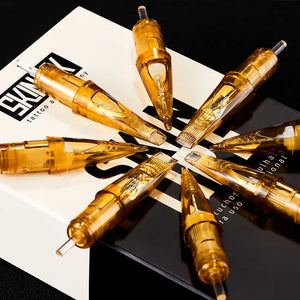
A cartridge is more than a disposable needle holder. Its grouping, diameter, taper, tip, membrane, and housing work together during every stroke. For professional tattoo artists and PMU specialists, high precision tattoo needle cartridges should provide predictable contact with the skin and a stable relationship between hand movement, machine motion, and pigment placement. The practical standard is repeatable behavior, not simply a sharp needle in a package.
Needle grouping, diameter, and taper
Grouping describes how many needles are arranged and how closely they sit together. Diameter is commonly discussed through gauge, such as 04, 06, or 08, while a code such as 0403, 0405, or 0407 may identify a small-diameter needle with a particular taper. Artists should read the manufacturer specification rather than assume that a code means the same thing across every range.
A smaller 04 needle can support delicate work, but it may place less pigment per pass and expose more technique-related variation. A 06 or 08 may create a fuller mark and carry pigment more readily, although it can be less forgiving on fragile or highly reactive skin. Taper then changes how gradually the needle reaches the skin, so diameter and taper should be evaluated as a pair.
Tip geometry and ink flow control
The cartridge tip controls visibility around the needle grouping and helps guide pigment toward the working area. A narrow, clear tip can be useful for close detail, while a broader tip may offer a different view and flow pattern during shading. The correct choice depends on the artist’s stroke, pigment viscosity, machine settings, and the skin being worked.
An anatomical tip and internal retention shells are documented features of Skin Ink USA Fine Line Cartridges, which are described for ultra-fine lines, dotwork, and intricate details. That documented scope makes the configuration relevant to fine detail, but it does not remove the need to tune hand speed and machine behavior.
Membrane design and needle stability
The membrane separates the needle movement from the cartridge interior while helping limit backflow. A flexible membrane can allow needle-bar movement without making the grouping feel loose, but excessive flexibility or poor alignment may increase deflection. Stability is felt as a controlled, repeatable response rather than as a single measurable feature.
Artists should observe whether the needle returns cleanly, whether the tip remains centered, and whether pigment or fluid appears where it should not. These checks belong to setup and process control, not to improvisation during a client session.
Manufacturing tolerances and quality control
Precision depends on consistency between cartridges in the same box as well as between different production batches. Bent needles, uneven soldering, irregular spacing, rough plastic, or inconsistent membranes can alter the result even when the printed configuration is identical. A professional evaluation therefore includes several cartridges, not only the first one opened.
The cartridge anatomy guide provides a useful framework for considering housing, alignment, membrane mechanics, quality control, and machine integration. Those factors should be treated as a connected system when an artist compares products or investigates a sudden change in line quality.
How cartridge configurations affect tattooing results
Configuration changes the width, softness, pigment load, and contact pattern of a stroke. A round liner concentrates needle points for defined marks, a round shader spreads contact more gently, and a magnum distributes work across a wider area. Curved or specialized groupings alter the way the needle edge meets uneven surfaces. The artist’s objective should determine the grouping before voltage or hand speed is adjusted.

Round liners for controlled linework
Round liners are arranged to produce concentrated lines and controlled detail. They are often used for outlines, lettering, small marks, and deliberate texture, but the final line still depends on gauge, taper, depth, skin response, and movement. A tight grouping does not automatically create a perfect line if the cartridge deflects or the hand speed changes.
For a closer review of configuration and application, the Round Liner cartridge guide discusses sharp outlines, intricate details, and consistent linework. Artists can use that kind of reference to compare 0403, 0405, and 0407 options without treating one size as universally correct.
Round shaders for packing and soft transitions
Round shaders place needles in a less concentrated arrangement, creating a broader and softer contact pattern than a round liner. They can suit filled strokes, gradients, and smaller shaded areas where a magnum would be unnecessarily wide. The artist should still regulate passes carefully; repeated work over the same area can increase trauma regardless of the cartridge type.
A useful test is to compare how quickly a round shader reaches the intended value and how evenly it leaves the edges of a transition. Softer contact can improve blending, but too much movement or too little pigment control may produce a weak, uneven result.
Magnum configurations for shading and color saturation
Magnums cover more surface than round groupings and are commonly chosen for broad shading, color packing, and gradual transitions. Straight and curved arrangements distribute contact differently, with curved edges often changing how the grouping moves across the skin. Larger configurations may reduce the number of passes, but they also require disciplined stretching, angle control, and awareness of skin condition.
The MAGNUM ROUND CARTRIDGE is documented as an RM configuration with a two-row curved needle arrangement for controlled skin contact and minimal trauma. Its stated applications include realism, black and grey, and gradient tattoos; those applications describe a suitable use range, not a guarantee for every artist or skin type.
Curved and specialized groupings for surface control
Curved groupings can conform differently across contours such as shoulders, arms, and legs. Specialized arrangements may improve access to a particular edge or transition, but they can also feel unfamiliar if the artist changes angle or pressure without testing first. Surface control comes from the combination of grouping geometry and technique.
The artist should make short test marks on an approved practice surface and observe edge behavior before committing to a large pass. This is especially relevant when moving between tattoo work and PMU procedures, where scale and pigment behavior may differ substantially.
Choosing needle specifications for the application
Selection becomes more reliable when the artist starts with the intended mark rather than a favorite cartridge. Line weight, pigment density, design scale, skin response, and hand speed all influence the choice. The same configuration can behave differently in a slow, controlled pass than in a fast packing motion. A written selection process reduces unnecessary changes during the appointment.
Matching diameter to line weight and skin response
Gauge is a practical starting point: 04 generally indicates a finer diameter than 06 or 08, though the exact dimensions should be confirmed in the product specification. A 0403 may suit a finer controlled mark, while 0405 or 0407 may offer more body within the same general family. The artist should consider whether the skin is thin, resilient, oily, scarred, or already irritated.
Fine needles can require more deliberate pigment management, while larger diameters can create stronger saturation with fewer passes. Neither is inherently safer or more precise in every situation; depth, speed, pressure, and aftercare remain decisive.
Selecting taper length for precision or saturation
A long taper exposes the needle gradually and can support fine, controlled marks when the artist maintains a consistent angle. A shorter taper may deliver pigment more readily and can feel more direct during saturation. These are trade-offs, not fixed rankings.
The fine-line configuration reference is relevant when an artist is comparing sharpness, taper, membrane stability, and testing for detailed work. A long taper should not be selected solely because the design is small; the artist must also be able to control the slower, more deliberate ink delivery it may produce.
Adjusting group size to the tattoo scale
Small designs and narrow passages usually benefit from compact groupings that preserve access to the edge. Larger designs can justify magnums that cover more surface efficiently. A large grouping in a confined area may obscure the stencil or make it difficult to place pigment precisely, while a very small grouping on a large fill can extend the number of passes.
The practical question is whether the grouping gives enough coverage without forcing repeated trauma. The answer changes with the design, skin, pigment, and artist’s established movement pattern.
Balancing needle configuration with hand speed
Hand speed determines how long the needles remain in contact with each section of skin. A fast hand with a low-pigment configuration may leave a weak result, while a slow hand with an aggressive grouping can overwork the area. Machine voltage and needle travel should be adjusted only after the artist understands the cartridge’s baseline behavior.
A useful setup sequence is deliberately simple:
- Confirm the printed configuration and gauge.
- Check the needle tip, membrane, and housing under good light.
- Run a short test at the intended machine settings.
- Compare line, saturation, and recovery before beginning the main pass.
This sequence gives the artist a reference point. It also makes it easier to identify whether a problem comes from technique, machine settings, pigment, or the cartridge itself.
Evaluating cartridge performance in practice
A cartridge earns a place in a professional setup through repeated observation. Artists should assess the first strokes, the middle of a pass, and the point at which pigment begins to behave differently. Performance includes line consistency and saturation, but also feedback through the machine and comfort in the hand. A product that performs well only under one narrow set of conditions may not be the most useful studio standard.

Assessing line consistency and needle deflection
A consistent line should not widen unpredictably when pressure and speed remain stable. Deflection can appear as a wandering edge, uneven needle contact, or a grouping that seems to shift against the tip. Artists can inspect test marks at several angles and compare them with the intended stroke.
The comparison should be made with similar skin preparation and machine settings. Otherwise, a change in lubrication, stretch, or movement may be mistaken for a manufacturing difference.
Measuring ink delivery and saturation
Ink delivery is best judged by the amount of pigment placed in a controlled pass and by the evenness of the result after the surface is cleaned. Excessive spit-back, repeated dipping, or patchy coverage can indicate a mismatch among cartridge, pigment, machine, and technique. A broad grouping may cover quickly but still require careful edge work.
The Big Magnum Round cartridges are documented for greater needle counts, large-area coverage, and styles including blackout, oriental, and realism. That makes them a logical comparison point for large-scale work, while smaller configurations remain more practical for confined details.
Managing vibration, feedback, and hand fatigue
Machine feedback helps an artist sense how the needle is meeting the skin. Excess vibration can make a precise stroke harder to maintain and can increase fatigue over a long session. Grip weight, machine balance, cartridge fit, needle travel, and hand pressure all contribute to that sensation.
Artists should record comfort separately from visible results. A cartridge that produces acceptable saturation but forces excessive pressure or awkward compensation may be a poor choice for repeated use.
Identifying inconsistent cartridges during setup
Before client work, the cartridge should be checked for a centered tip, intact housing, smooth needle movement, and an undamaged membrane. A short test can expose uneven grouping or abnormal flow. If a cartridge behaves differently from the rest of the box, it should be isolated rather than repeatedly adjusted around.
A simple comparison table can help a studio separate observations from assumptions:
| Observation | Possible source | Practical response |
|---|---|---|
| Uneven line width | Deflection, angle, or hand speed | Inspect tip and repeat a controlled test |
| Patchy saturation | Grouping, pigment, or machine setting | Compare with a known setup |
| Excessive vibration | Fit, travel, or machine balance | Check cartridge seating and travel |
| Fluid or ink in the housing | Seal or membrane problem | Stop using the cartridge and follow disposal procedure |
The table is not a diagnostic substitute, but it gives the artist a consistent first pass. Documentation becomes more useful when the studio records the actual configuration and conditions rather than simply marking a cartridge as good or bad.
Ensuring machine and cartridge compatibility
Universal fit is a useful description, not permission to skip a fit check. Cartridge interfaces can differ in seating, grip behavior, needle travel, and how far the needle extends at a given machine setting. Rotary machines may respond differently from one another even when the cartridge enters the grip cleanly. Compatibility should therefore be tested as a mechanical and operational question.
Comparing universal and proprietary cartridge systems
Universal-fit cartridges are designed to work with a broad range of compatible machines, while proprietary systems may depend on a specific grip or drive arrangement. The relevant question is whether the cartridge locks securely, maintains alignment, and provides the intended travel without wobble. Marketing language should never replace the machine manufacturer’s compatibility information.
Some Skin Ink USA cartridge pages document universal compatibility, including the Fine Line range and the Round Magnum range. That claim should be read literally: universal fit supports use with compatible universal-fit machines, but the artist still needs to verify the particular grip and machine combination.
Checking cartridge fit, grip, and needle travel
The cartridge should seat fully and remain stable when the grip is moved through its normal adjustment range. The artist should check that the needle does not retract unexpectedly, scrape the tip, or extend farther than intended. A loose fit can create inconsistent contact even when the machine sounds normal.
Needle travel also changes the character of a stroke. It should be evaluated with the selected configuration, because a machine setting that works well for a liner may not provide the same result with a broad magnum.
Matching cartridge performance to rotary machines
Rotary machines transfer motion through a drive mechanism that can feel different across stroke lengths, give, and operating speeds. The cartridge must remain stable as the machine cycles, and the artist must tune hand speed and voltage to the actual response rather than to a preset copied from another setup.
The machine, cartridge, and pigment should be treated as one working combination. Changing one component can alter feedback and saturation enough to require a fresh test.
Testing compatibility before client work
A compatibility check should happen before the client is positioned and before sterile components are opened unnecessarily. The artist can use a practice surface or other approved test method to confirm seating, travel, flow, and control. This also provides a chance to identify a cartridge that is mechanically sound but poorly matched to the intended technique.
If the fit is uncertain, the cartridge should not be forced into the grip. Replacing it is safer and more efficient than trying to compensate during a permanent procedure.
Maintaining sterile and compliant cartridge workflows
Sterility begins with procurement and continues until the cartridge is opened for the procedure. A professional workflow separates unopened sterile supplies from used equipment and follows local health regulations. ANVISA requirements may apply in relevant jurisdictions, while other regions may have different rules; artists and studios should verify the regulations governing their location. Packaging evidence and disposal practices should be documented consistently.
Verifying individual sterile packaging
Each cartridge should be individually packaged for single use, with the package opened only after the station is prepared. The artist should avoid placing sterile cartridges on unprotected surfaces or handling them unnecessarily. If the package is opened prematurely, its status must be treated according to studio policy and applicable regulation.
Inspecting expiration dates and package integrity
The expiration date and lot information should be checked before opening. Tears, punctures, moisture, broken seals, or unclear labeling are reasons to reject the package. A cartridge can look unused while its sterile barrier has already been compromised.
Studios should retain purchase and lot records when required by policy or regulation. Those records make stock rotation easier and support a clear response if a product question arises.
Using barrier protection and safe disposal
Barriers should protect the machine, grip, cords, work surface, and other equipment that may be exposed to ink or bodily fluids. Used cartridges belong in an approved sharps container immediately after use. They should never be recapped, reused, or placed loose in general waste.
The cartridge is disposable, but the surrounding equipment still requires cleaning and disinfection according to the studio’s protocol. Barrier protection reduces contamination; it does not eliminate the need for proper decontamination.
Separating sterile components from contaminated equipment
A clean station should have a defined area for unopened supplies and a separate route for used items. The artist should open only what is needed and keep sterile components away from contaminated gloves, rinse cups, and used barriers. This arrangement reduces accidental contact during busy procedures.
Workflow discipline matters as much as product selection. A technically consistent cartridge cannot correct a break in aseptic handling.
Building a reliable cartridge selection system
A reliable system turns individual preferences into records that another trained artist can understand. It should connect configuration, gauge, taper, machine, pigment, skin condition, technique, and observed result. This is especially valuable for studios that perform both tattooing and PMU procedures, where the working scale and control requirements can differ. The objective is not to create a rigid rulebook, but to make useful decisions repeatable.
Creating a configuration matrix for common styles
A matrix can begin with a few practical categories: fine detail, controlled lining, small-area shading, broad saturation, and soft gradients. Each category should list the preferred grouping, gauge, taper, machine, and test result. Codes such as 0403, 0405, and 0407 can be recorded alongside the manufacturer’s stated dimensions.
The matrix should remain flexible. It is a decision aid, not a claim that one cartridge will behave identically on every client.
Standardizing preferred cartridges by use case
Standardization reduces setup time and makes stock management more predictable. For instance, a studio may keep a tested liner for lettering, a shader for compact gradients, and a magnum for broad fills, while preserving alternatives for different skin responses. Standardization works only when each preferred option has been tested under realistic conditions.
The Fine Line Cartridges are documented for ultra-fine lines, dotwork, and intricate details, while the MAGNUM ROUND CARTRIDGE is documented for curved, broader shading applications. Those two documented scopes illustrate why a studio matrix should organize cartridges by use case rather than by brand reputation alone.
Comparing cost per usable cartridge
Unit price is only one part of cartridge cost. A cartridge that performs consistently may reduce wasted setup time and unnecessary replacement, while an inexpensive cartridge that is rejected frequently may cost more in practice. Studios should calculate cost per usable cartridge from actual purchasing and rejection records.
The calculation should include shipping, packaging quantities, unusable units, and any time lost to troubleshooting. It should not turn a lower price into a reason to compromise sterile packaging or mechanical reliability.
Documenting performance across skin types and techniques
Records should distinguish observed performance from guaranteed results. An artist can note line consistency, saturation, feedback, comfort, and skin response across several sessions, while protecting client privacy and following studio documentation rules. Patterns become meaningful only after repeated use with comparable technique.
A short review after each session is usually enough: configuration, gauge, taper, machine setting, pigment, skin characteristics, and result. Over time, that record supports more precise purchasing and more honest troubleshooting.
Conclusion
High precision tattoo needle cartridges perform best when their specifications match the intended mark, the machine fit is confirmed, and sterile handling is treated as part of technical quality. Professional artists and PMU specialists can improve repeatability by testing configurations, recording real observations, and choosing documented features without overstating what any cartridge can deliver.
Frequently Asked Questions
What do 0403, 0405, and 0407 mean in tattoo cartridges?
These codes commonly describe a needle diameter and taper combination, but the exact meaning should be confirmed against the manufacturer’s specification. Gauge terms such as 04, 06, and 08 also indicate diameter families and should not be assumed identical across brands.
Is a 04 gauge cartridge always better for fine lines?
A 04 cartridge may support a finer mark, but line quality also depends on taper, grouping, needle stability, machine settings, hand speed, and skin response. A smaller diameter is not automatically the best choice for every fine-line procedure.
What is the difference between a round liner and a round shader?
A round liner concentrates needle points for defined lines and detail. A round shader spreads the points more broadly for softer shading, filled strokes, gradients, and compact coverage.
When should an artist choose a magnum cartridge?
A magnum is generally considered when broader shading, color packing, or large-area coverage is required. The artist should select straight, curved, or other specialized arrangements according to surface shape and the intended pigment placement.
Are universal-fit cartridges compatible with every tattoo machine?
No. Universal fit indicates compatibility with a broad class of compatible machines, not every machine without verification. Seating, grip design, needle travel, and drive behavior should be checked before client work.
How should a cartridge be checked before use?
The artist should inspect the sterile package, expiration date, seal, housing, tip, membrane, and needle alignment. A controlled test can then confirm fit, travel, flow, vibration, and the expected result before the procedure begins.
Can tattoo needle cartridges be reused?
Disposable tattoo cartridges should not be reused. After the procedure, the used cartridge should be placed directly into an approved sharps container, while exposed equipment is handled through the studio’s cleaning and disinfection protocol.