Key Takeaways
Fine line work depends on the interaction between needle geometry, machine control, skin, and technique rather than on a single cartridge code.
- Match 04, 06, or 08 gauge to the intended line weight and pigment delivery.
- Treat 0403, 0405, and 0407 as configuration references, not guarantees of identical performance.
- Use taper, grouping, membrane response, and tip visibility to assess a module properly.
- Adjust hand speed, voltage, needle hang, and skin stretch together.
- Record results by technique, placement, skin response, and healed appearance.
Fine line cartridge specifications that affect performance
Fine line cartridges are precision tools, but their printed size is only the beginning of the evaluation. Needle diameter, grouping, taper, membrane tension, and tip construction all influence how a cartridge behaves in the hand. A professional artist or PMU specialist should read the code and then assess the complete module as a working system.
Needle count, diameter, and taper length
Needle count affects the width and density of the mark, while diameter affects pigment delivery and the visual weight of the line. A 04 gauge is commonly selected when a particularly delicate mark is required; 06 and 08 gauge options generally provide more body and saturation. Codes such as 0403, 0405, and 0407 combine gauge information with grouping, so the artist should confirm the manufacturer’s coding convention before comparing modules.
Taper length changes how gradually the needles enter the skin and how much ink they carry during a stroke. A long taper can feel more measured and controlled for delicate work, but it may require a steadier hand and a suitable machine response. A shorter taper can place pigment more readily, although excessive saturation may become a liability on small or fragile designs.
Round liner configurations for precision
Round liners group needles closely around a central point, making them a natural choice for contours, lettering, and small details. A 3RL or 5RL can provide more visual presence than a 1RL while remaining narrower and more controlled than larger groupings. The exact result still depends on needle alignment, tip geometry, machine movement, and the artist’s pass speed.
The fine line cartridge guide is useful when comparing configurations such as 0803RL, 1003RL, 1203RL, and 1005RL. Its practical value is in relating gauge, grouping, taper, design, and skin type instead of treating the code as the entire decision.
Membrane design and ink flow control
The membrane separates the needle bar from the ink path and helps regulate movement while reducing the chance of backflow. A membrane that is too soft may permit excess movement or inconsistent needle return; one that is too stiff can make the machine feel resistant. The correct response is not simply the tightest membrane, but a predictable one that suits the machine and technique.
Ink viscosity, dipping frequency, cartridge orientation, and tip cleanliness also affect flow. Consistent ink delivery matters because a sharply grouped needle cannot produce a stable line if the pigment arrives intermittently. Artists should assess whether a module maintains flow through a complete stroke rather than judging it from a single pass.
Tip geometry, stability, and visibility
The tip should hold the needle grouping securely and give the artist a clear view of the contact point. An anatomical or tapered tip may improve visibility around curves and small shapes, while a broader housing can provide more structural support. The choice is a balance: visibility helps precision, but a tip that flexes or catches against the skin can undermine it.
Cartridge stability also depends on the housing, needle bar movement, and machine fit. A module can be sharp yet difficult to control if the housing vibrates, the needle alignment varies, or the tip collects excess ink. Close inspection under good lighting is worthwhile before the cartridge reaches the client.
How cartridge configurations change line quality
Line quality is the visible result of several small mechanical decisions. Needle grouping controls edge definition, taper influences softness and saturation, and gauge changes the amount of pigment delivered per movement. The most suitable fine line cartridges are therefore selected according to the mark required, not simply the smallest available number.

Comparing 1RL, 3RL, 5RL, and specialty liners
A 1RL is suited to extremely narrow details when the artist can maintain a consistent hand and machine speed. A 3RL offers a little more stability and presence, making it useful for delicate outlines that must remain readable. A 5RL produces a stronger, more forgiving line for small lettering, defined contours, and details that need greater visual weight.
Specialty liners may alter needle arrangement, taper, or tip construction to produce a particular response. They should be judged on healed readability, ink control, and skin response rather than on the promise of an ultra-fine initial mark. A line that appears narrow during application but heals weakly may require a more substantial configuration.
Matching taper length to line softness
Long taper configurations tend to distribute pigment more gradually, which can help with controlled, delicate lines and subtle transitions. They may also expose inconsistencies in hand speed because a slow pass can overwork the same area. Shorter tapers often feel more immediate and saturated, but that efficiency requires restraint on thin skin or compact designs.
The artist should compare tapers at the same gauge and grouping whenever possible. Otherwise, a change in line quality may be attributed to taper when it actually comes from diameter, machine stroke, or hand speed.
Choosing cartridges for micro-details and small text
Micro-details require enough definition to survive healing and normal visual distance. For tiny text, the artist must consider letter height, spacing, skin movement, and the client’s expectations before selecting a 1RL, 3RL, or 5RL. A slightly fuller line can remain more legible than an exceptionally thin line that loses pigment during healing.
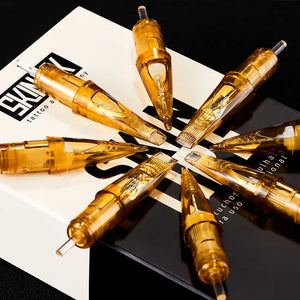
The Skin Ink USA Fine Line Cartridges are documented for ultra-fine lines, dotwork, intricate details, calligraphy, geometric tattoos, and micro-realism. The product page also specifies a long taper, flexible silicone membrane, SUS 304 stainless steel needles, and universal fit; those documented characteristics can be compared directly with the artist’s machine and technique.
Balancing saturation, consistency, and skin trauma
A fine line is not successful merely because it is narrow. It must carry enough pigment to heal with clarity without repeated passes that create unnecessary irritation. Larger groupings and shorter tapers may increase saturation, while smaller groupings and longer tapers can demand more precise control.
The balance changes with placement and skin condition. A professional should avoid chasing an outline by repeatedly retracing a weak mark; first, the machine speed, needle depth, ink flow, and cartridge condition should be checked. The best setup is the one that reaches the intended healed result with controlled, limited skin trauma.
Selecting fine line cartridges for different techniques
Technique determines how a cartridge is asked to behave. A single-pass contour needs alignment and dependable flow, while stippling or whip shading relies on controlled variation in contact and speed. Artists working across tattooing and PMU should also account for different skin conditions, pigment behaviour, and the visual scale of the procedure.
Single-pass outlines and delicate contours
Single-pass outlines place a premium on a stable grouping and a tip that remains visible throughout the movement. A 3RL can give a delicate contour more support than a 1RL, while a 1RL may suit isolated interior details and extremely small marks. Curves are often easier when the artist moves at a pace that allows the machine to deposit pigment without dragging.
The Round Liner cartridges from Skin Ink USA are documented for sharp outlines, intricate details, consistent linework, lettering, and micro-realism. The page specifies SUS 304 stainless steel and an advanced sealing system, so the documented product characteristics fit the needs of controlled lining without extending the claim beyond those uses.
Stippling, whip shading, and soft transitions
Stippling depends on repeated, separated contacts rather than a continuous saturated line. A fine grouping can create delicate dots, but the artist still needs a machine response that returns the needle predictably. Whip shading requires a controlled lift and release; a cartridge that deposits too much pigment at the start of each movement can make the transition look abrupt.
Soft transitions should be built through spacing, speed, and pressure rather than by forcing a liner to act like a shader. When a broader tonal field is required, the artist should change to a configuration designed for that job instead of overworking a fine liner.
Botanical details, geometric work, and lettering
Botanical work combines thin stems, leaf veins, and occasional stronger contours, so a small assortment is usually more useful than one universal choice. Geometric work exposes wobble and inconsistent depth, making alignment and machine stability especially important. Lettering adds another constraint: the line must remain readable after healing, including at joins and tight counters.
The round liner configuration guide provides a technical way to compare grouping, diameter, taper, pigment flow, and saturation across delicate realism and lettering. Those variables are more transferable between styles than a vague label such as “ultra fine.”
Adjusting cartridge choice for skin type and placement
Thin, mobile, or highly sensitive skin may require fewer passes, conservative depth, and a configuration that delivers enough pigment without aggressive movement. Areas exposed to friction and sunlight also place greater demands on long-term readability. On flatter, more stable placements, the artist may have greater freedom to use a finer grouping and a longer taper.
Skin should be assessed in its actual working position, not only while it is relaxed. A careful stretch, suitable angle, and short test mark can reveal whether the chosen cartridge is too saturated, too light, or difficult to control.
Machine setup and needle control
A fine line cartridge cannot compensate for an unsuitable machine setup. Voltage, stroke, hand speed, needle hang, depth, angle, and stretch interact continuously during the procedure. Small adjustments should be made methodically, because changing several variables at once makes the result difficult to diagnose.

Setting voltage, stroke, and hand speed
Voltage should be selected according to the machine, stroke, cartridge resistance, pigment, and artist’s movement rather than copied as a universal number. A longer stroke may provide useful reach but can feel more forceful, while a shorter stroke may suit controlled detail. Hand speed must remain synchronized with the machine: moving too quickly can create weak lines, while moving too slowly can overwork the skin.
The artist should begin from a known setting, make one modest adjustment, and test the change on practice skin or a controlled area. A setup that sounds efficient but produces inconsistent deposition is not efficient in practice.
Controlling needle hang and needle depth
Needle hang affects visibility and the amount of exposed needle available for the stroke. Excessive hang can make depth harder to control, particularly on curved or mobile areas. Insufficient hang can obscure the contact point and encourage the artist to compensate with pressure.
Depth should be controlled by the machine setting, hand pressure, stretch, and movement together. The goal is consistent pigment placement, not maximum penetration. PMU specialists should be especially conservative where skin is thin or the procedure has a narrow tolerance for overworking.
Managing stretch, angle, and movement
A stable stretch gives the cartridge a more predictable surface, but the direction and amount of stretch must suit the placement. The machine angle should allow the tip to travel without scraping or catching. Curves are generally cleaner when the artist moves from a stable position and rotates the working area rather than twisting the wrist through the entire contour.
The needle control guide discusses cartridge inspection, machine compatibility, voltage, stroke, hand speed, needle depth, and ink-flow factors. It is a useful reference for isolating setup variables before blaming the cartridge for an avoidable control problem.
Preventing vibration, snagging, and inconsistent lines
Vibration may come from the machine, cartridge fit, needle alignment, or an unstable grip. Snagging can indicate an angle problem, excessive hang, a damaged tip, insufficient lubrication from the ink, or skin that has not been held adequately. Each symptom should be observed during a short test movement rather than inferred from the healed result alone.
Before proceeding, the artist should check the cartridge connection, listen for unusual mechanical noise, inspect the tip, and confirm that the needle returns smoothly. A clean, repeatable test is safer than trying to correct a visibly unstable line on the client.
Hygiene, compatibility, and cartridge quality control
Cartridge quality control begins before the machine is powered on. Sterility, packaging integrity, expiration status, fit, sealing, and visible needle alignment all belong in the pre-procedure check. This is particularly important for professionals who move between tattooing, PMU, and multiple machine systems.
Checking sterile packaging and expiration dates
The package should be intact, dry, correctly identified, and within its stated expiration period. If a seal is broken, punctured, wet, or otherwise compromised, the cartridge should not be used. Sterile single-use practice also requires clean handling from opening through disposal.
Regulatory requirements vary by jurisdiction and procedure. Artists and studios operating in Brazil should verify the applicable ANVISA requirements rather than assuming that a general cartridge label addresses every local obligation. Documentation and purchasing records should be retained according to the studio’s compliance process.
Verifying cartridge fit across machine systems
“Universal fit” is meaningful only when the cartridge physically locks into the intended machine and maintains stable needle movement. The artist should verify the machine connection, drive compatibility, needle travel, and cartridge seating before beginning. A fit that feels loose can produce vibration, inconsistent depth, and unnecessary fatigue.
Skin Ink USA Fine Line Cartridges are documented as compatible with universal fit tattoo machines. That statement should still be checked against the specific machine model in use, because machine tolerances and drive mechanisms can differ even when a connection is described as universal.
Identifying defects before starting a tattoo
A pre-use inspection should look for a distorted tip, loose housing, damaged membrane, visible contamination, irregular needle grouping, and unusual movement when the machine is briefly tested. Defects are easier to identify before ink reaches the skin. If the cartridge does not look or sound correct, it should be isolated rather than rationalized.
Batch consistency also matters. Artists who notice repeated variation should record lot information and contact the supplier through the appropriate quality channel, keeping the affected packaging where possible.
Using safe procedures for setup, changeover, and disposal
Hands, barriers, machine surfaces, and work areas should be prepared according to the studio’s infection-control protocol. The cartridge should be opened without touching critical sterile surfaces, changed with care, and discarded immediately in an approved sharps container after use. Reusing a single-use cartridge is not an acceptable way to reduce operating cost.
At changeover, the artist should prevent contact between used components and clean supplies. The same discipline applies when moving from one configuration to another during a long appointment.
Troubleshooting common fine line cartridge problems
Troubleshooting works best as a process of elimination. Weak lines, blowouts, uneven deposition, poor flow, and skin irritation can have several overlapping causes. The artist should compare the line, machine sound, ink behaviour, skin condition, and cartridge integrity before making a correction.
Diagnosing weak, blown-out, or uneven lines
Weak lines may result from excessive hand speed, insufficient depth, restricted ink flow, a taper that does not suit the setup, or a grouping too fine for the intended mark. Blowouts generally suggest excessive depth, pressure, or repeated passes, although placement and skin structure also matter. Uneven lines can point to vibration, inconsistent stretch, or a needle grouping that is not aligned.
A controlled test line can separate a machine problem from a placement problem. If the same cartridge performs consistently on practice skin but not on the client, the artist should reassess stretch, angle, depth, and skin response before changing modules repeatedly.
Correcting ink flow and needle-bounce issues
Intermittent flow may be caused by pigment viscosity, inadequate dipping, a clogged tip, membrane behaviour, or an unsuitable machine setting. Needle bounce may appear as dotted or skipping movement and can be related to speed, voltage, stroke, grip, or cartridge fit. The safest correction is incremental: clean the tip, confirm the connection, adjust one setting, and test again.
Artists can also consult the cartridge troubleshooting resource, which covers diameter, gauge, taper, grouping, membrane mechanics, machine integration, and issues such as spit-back. The reference supports a structured diagnosis rather than a reflexive change of needle size.
Reducing excessive skin trauma and irritation
Trauma increases when the artist makes too many passes, works too slowly with excessive pressure, uses unsuitable depth, or asks a fine liner to deliver more saturation than it can manage cleanly. Redness and swelling should be read alongside the line itself. A technically narrow mark is not a successful result if the surrounding skin has been unnecessarily stressed.
The artist should reduce passes, reassess machine movement, and choose a more suitable grouping or taper for the required saturation. Client-specific factors and placement should guide the decision, with local professional and medical protocols taking priority when a reaction appears unusual.
Knowing when to change cartridges during a session
A cartridge should be changed when the tip is damaged, the needle grouping becomes unreliable, flow remains inconsistent after basic checks, contamination is suspected, or the module no longer sits securely. It may also be appropriate when the technique changes substantially and a different configuration is required.
Changing early is preferable to compensating with pressure or repeated passes. The used cartridge should be disposed of safely, and the replacement should undergo the same packaging and visual inspection as the first.
Building a practical fine line cartridge selection system
A useful selection system turns isolated preferences into repeatable decisions. Instead of collecting every available code, the artist can build a small range around common line weights, tapers, placements, and techniques. The system should remain flexible enough for tattooing and PMU without pretending that one cartridge behaves identically in every context.
Creating a core cartridge assortment
A practical starting assortment may include 04 gauge options for highly delicate details, 06 or 08 gauge options for more readable fine lines, and several groupings such as 1RL, 3RL, and 5RL. The selection should cover both narrow contours and slightly stronger lettering or botanical marks. Additional specialty liners can be added when a repeated technique justifies them.
A compact kit might be organized like this:
- 04 1RL or comparable fine grouping for isolated micro-details.
- 04 3RL for delicate contours with added stability.
- 06 or 08 3RL for readable, lightly weighted outlines.
- 06 or 08 5RL for small lettering and stronger detail.
This assortment gives the artist a controlled range without forcing every design into the smallest configuration. It also makes it easier to compare results across appointments.
Testing new modules on practice skin
Practice skin is useful for checking alignment, flow, tip visibility, machine response, and the relationship between speed and voltage. It cannot reproduce every characteristic of living skin, so it should be treated as a mechanical screening step rather than proof of healed performance. The artist should test straight lines, curves, dots, joins, and small lettering when relevant.
A new cartridge should be compared with a familiar module under similar settings. That comparison reveals whether the difference comes from the cartridge or from an accidental change in technique.
Recording settings, results, and skin responses
A brief record can include cartridge code, gauge, grouping, taper, machine, stroke, voltage range, hand speed, pigment, placement, and observations during healing. Photographs should be taken consistently and, where appropriate, include real in-use photos rather than stock imagery. Healed photographs are more informative than fresh-line close-ups alone.
Over time, these records reveal which configurations remain readable, which create excessive irritation, and which require repeated adjustments. They also give the artist a defensible basis for refining a setup.
Evaluating cost, consistency, and long-term reliability
Unit price should be considered alongside rejected cartridges, interruptions, setup time, and the cost of correcting inconsistent work. A less expensive module is not economical if variation causes extra passes or unreliable healed results. Consistency across boxes and lots is especially valuable for studios that need repeatable procedures.
Skin Ink USA Fine Line Cartridges are documented for smooth, uninterrupted ink flow, an anatomical tip, internal retention shells, long taper technology, SUS 304 stainless steel, and universal fit. Those are product-specific specifications to evaluate against actual studio records; they should not be treated as a guarantee of identical results for every artist, machine, or client.
A selection system becomes useful when it remains evidence-based. The artist can keep the configurations that perform predictably, retire those that create recurring problems, and continue testing only when a genuine technical need appears.
Conclusion
Fine line cartridges perform best when their gauge, grouping, taper, membrane, and tip geometry are matched to the design and controlled through disciplined machine setup. Professional artists and PMU specialists can improve consistency by testing modules methodically, respecting hygiene and compatibility requirements, and judging success by controlled application and healed readability rather than by an impressively narrow fresh line.
Frequently Asked Questions
What do 0403, 0405, and 0407 mean?
These codes commonly describe a 04 gauge needle paired with a grouping of three, five, or seven needles, but coding conventions should be confirmed with the manufacturer. The code alone does not describe taper, membrane, tip, or final line behaviour.
Is a 1RL always best for fine line tattoos?
No. A 1RL can produce a very narrow mark, but a 3RL or 5RL may offer better stability, readability, and saturation for some designs. The suitable choice depends on scale, placement, skin, machine response, and the intended healed line.
How do 04, 06, and 08 gauges differ?
A 04 gauge generally supports a more delicate line, while 06 and 08 gauges can provide greater visual weight and pigment delivery. The actual result also depends on grouping, taper, speed, depth, and the number of passes.
What does taper length change?
Taper length affects how gradually the needles enter the skin and how pigment is delivered. Long tapers can support controlled, softer application, while shorter tapers may feel more immediate and saturated.
Why does a fine line cartridge skip?
Skipping can come from excessive hand speed, unsuitable voltage or stroke, insufficient stretch, poor angle, needle bounce, restricted ink flow, or an unstable cartridge connection. The artist should test one variable at a time.
How can skin trauma be reduced during fine line work?
Controlled depth, suitable hand speed, limited passes, proper stretch, and an appropriate cartridge reduce unnecessary irritation. If the line is weak, the artist should diagnose the setup rather than repeatedly retracing it.
When should a cartridge be discarded?
It should be discarded after single use and replaced immediately if its packaging is compromised, the tip is damaged, contamination is suspected, flow remains unreliable, or the housing no longer fits securely. Used cartridges belong in an approved sharps container.