Key Takeaways
A fine line tattoo depends on a coordinated decision about needle choice, scale, placement, artist technique, and long-term care.
- Thin lines still require deliberate control of depth, hand speed, and ink saturation.
- Design detail must be matched to the physical size and expected aging of the tattoo.
- Friction, ultraviolet exposure, and skin movement can accelerate fading or visual change.
- Healed portfolio work is more useful than fresh photographs when evaluating an artist.
- Consistent sunscreen use and realistic touch-up planning help preserve fine details.
What defines a fine line tattoo
A fine line tattoo is built around narrow, controlled marks rather than heavy outlines or dense color packing. The style can include blackwork, miniature illustration, lettering, geometric work, or delicate realism, but its defining quality is the relationship between line weight, spacing, and scale. A small design does not automatically qualify; the execution must retain a light and precise visual character.
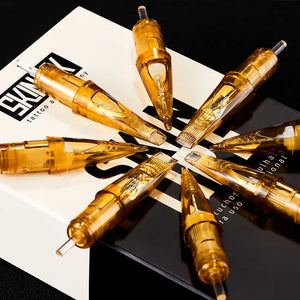
For professional tattoo artists and PMU specialists, the result is determined by more than the visible needle diameter. Cartridge stability, taper, grouping, machine response, hand speed, skin condition, and pigment flow all influence the healed line. The technical needle configuration guide is a useful reference when artists need to connect mechanical behavior with artistic intent.
Needle configurations and line-weight control
Fine line work commonly uses small round liner configurations, but the appropriate setup depends on the design and the artist’s technique. A 04 gauge may be selected when a particularly narrow mark is required, while 06 or 08 diameters can provide more visual presence and may be easier to control for longer or slightly bolder lines. In codes such as 0403RLF, 0405RLF, and 0407RLF, the first two digits give the needle diameter, the next two the number of needles, and the letters the grouping (RLF, round liner fine); they should be read alongside the manufacturer’s specifications rather than treated as interchangeable shorthand.
The round liner cartridge guide explains why configuration, taper, pigment flow, machine settings, and hand speed must be considered together. A smaller grouping can create a delicate result, but it also leaves less room for inconsistent depth or lateral movement. The artist’s goal is not the smallest possible line; it is a stable healed line that suits the drawing.
Blackwork, single-needle, and minimalist styles
Blackwork describes the use of black pigment and can range from delicate linework to dense, graphic coverage. Single-needle work is a technique associated with very narrow lines, while minimalist tattooing is primarily a design language based on restraint, simplified forms, and negative space. These terms overlap, but they are not synonyms.
A minimalist tattoo may use a 06 or 08 configuration if the design needs stronger readability. Conversely, a blackwork piece can include fine details without being visually delicate overall. Artists should assess the complete composition, including the darkest areas, rather than selecting a needle solely because the client requests a fine line tattoo.
How fine line differs from traditional tattooing
Fine line differs from traditional tattooing mainly in visual weight: traditional work uses heavier outlines, stronger saturation, and larger masses designed to stay legible from a distance. Fine line tattooing uses less visual weight and usually depends more heavily on spacing, subtle contrast, and clean transitions. That makes small errors, excess trauma, and crowded details more noticeable.
The difference is also practical. A fine line artist may need to slow down for a short contour, change direction carefully, or enlarge a feature that would disappear after healing. The fine line cartridge guide discusses configuration, taper, membrane tension, and machine compatibility as factors in creating clean, stable lines rather than treating delicacy as a simple needle-size choice.
Why skin type and ink saturation affect results
Skin varies in thickness, elasticity, texture, oiliness, and scar history, so identical settings will not produce identical results on every client. Ink placed too shallowly may heal weak or uneven, while excessive depth or repeated passes can create unnecessary trauma and increase the chance of spread. Saturation must therefore be judged against the skin’s response, not against the appearance of the fresh tattoo alone.
Artists should also account for existing scars, stretch marks, tanning, and areas of uneven texture. A line that looks exceptionally dark on the day of the appointment may soften considerably as the epidermis renews. Conversely, overworking a fragile area in an attempt to make it darker can compromise the healed finish.
How to choose a fine line tattoo design
Choose a fine line design that has been simplified for skin, with a readable silhouette, fewer tiny details, and a size that gives its smallest feature room to heal. A reference image may contain more information than skin can preserve at a small scale, and a client’s preferred digital image may need to be redrawn for the body rather than copied literally. The strongest designs establish a clear focal point, protect open space, and accept that some detail will need to be removed.
The design should also be judged at its intended size and from a normal viewing distance. A tattoo that reads beautifully on a large monitor may become a cluster of short marks when reduced. Consultation with an experienced artist helps translate the concept into a practical stencil while preserving its character.

Matching detail level to the tattoo’s size
The smaller the tattoo, the less detail it can hold, because every line and shape needs physical room to heal without merging into its neighbors. Tiny lettering, closely spaced petals, miniature facial features, and parallel geometric lines can merge when they are reduced too far. The artist should establish the smallest critical feature in the design and size the whole tattoo around that limitation, rather than sizing the piece first and forcing the details into it.
A useful test is to print or display the proposed stencil at actual size. If the image loses hierarchy before it reaches the skin, it will not become clearer through tattooing. Slight enlargement often produces a more refined result because it gives each mark enough separation to remain readable.
Selecting motifs that remain readable over time
Motifs with simple silhouettes and deliberate internal spacing generally age more predictably than crowded micro-illustrations. Botanical forms, symbols, restrained figures, and uncomplicated objects can work well when their defining contours remain clear. The artist should identify which marks are essential and which are merely decorative.
A design intended for long-term readability should avoid relying on a single hairline detail to communicate its meaning. Strong outer contours, controlled contrast, and a few carefully chosen interior marks give the image a better chance of remaining recognizable as pigment gradually softens.
Using negative space to prevent visual merging
Negative space is active design material. It separates adjacent lines, gives small shapes room to breathe, and reduces the likelihood that softened marks will become one dark patch. The amount required varies with placement, skin, size, and the density of the surrounding design.
The following checks help artists and clients discuss spacing before the stencil is applied:
- Separate parallel lines enough to survive gradual softening.
- Preserve open skin around the smallest enclosed shapes.
- Avoid stacking tiny text or symbols without a visual pause.
- Protect the main silhouette from secondary decorative marks.
These choices may make the fresh tattoo appear less detailed, but they usually improve its visual stability. Fine line work is not a contest to fill every available millimeter.
Converting reference images into tattoo-ready artwork
Reference images communicate mood, subject, and proportion; they are not necessarily tattoo-ready drawings. The artist may need to simplify tonal gradients, clarify the silhouette, remove photographic noise, and redraw contours so they can be transferred cleanly. Multiple references can also be combined, provided the final composition has one consistent visual language.
Clients should describe what must remain recognizable and what can change. This gives the artist room to adjust scale, orientation, and anatomical flow without losing the intended idea. A written approval of the final stencil or drawing reduces confusion, but it should not prevent necessary technical revisions at the appointment.
How placement affects fine line tattoos
Placement affects how quickly a fine line tattoo softens or fades: high-friction, sun-exposed, or highly mobile areas such as hands, fingers, and feet tend to lose fine detail sooner. The same design can heal differently on the inner arm, finger, rib, ankle, or upper back because friction, moisture, skin thickness, and movement are not uniform. Placement should therefore be part of the design brief from the beginning.
Visibility is another practical factor. A location that is easy to inspect can make aftercare simpler, while a high-contact area may require more maintenance. The most discreet placement is not always the most durable, and the most durable placement may not suit the client’s work or clothing.
High-friction areas that require caution
Hands, fingers, palms, feet, ankles, elbows, and areas beneath tight clothing are exposed to repeated rubbing, washing, pressure, and movement. Fine details in these locations may fade or soften sooner, and the healing period can be harder to protect. Artists should explain that placement affects maintenance rather than promising identical longevity across the body.
Moisture and friction can also irritate a fresh tattoo. A client who works with gloves, wears restrictive footwear, exercises frequently, or handles abrasive materials may need a different placement or a more conservative design. The decision should account for the client’s routine, not only the desired appearance.
Sun exposure and its impact on fading
Ultraviolet exposure contributes to fading and can make delicate contrast appear less distinct over time. Areas that receive regular sun, such as the forearms, shoulders, hands, and lower legs, need consistent protection once the tattoo has fully healed. Fresh tattoos should not be covered with sunscreen until the skin barrier has recovered and the artist’s aftercare instructions allow it.
Sun protection does not freeze a tattoo in its original state, but it reduces one avoidable source of deterioration. Clothing, shade, and broad-spectrum sunscreen can work together, especially for clients whose work or recreation keeps the tattoo outdoors.
Skin movement, stretching, and anatomical flow
Joints and flexible areas change shape whenever the body bends, contracts, or rotates. A design that looks balanced at rest may appear compressed or elongated in motion, so stencil positioning should be checked in several natural positions. Stretching from weight change or pregnancy can also alter the spacing and proportions of a tattoo, although the degree varies between individuals.
Anatomical flow matters even on relatively stable areas. A fine contour should follow the body’s direction instead of fighting it, and the design’s orientation should be clear when the limb is relaxed and when it moves. These adjustments improve visual coherence without requiring more detail.
Choosing placement based on visibility and maintenance
The best placement balances how visible the client wants the tattoo to be, including at work, with how easily the area can be kept out of the sun and cared for. A client should consider whether the tattoo will be exposed to sun, frequently washed, covered by equipment, or difficult to reach when moisturizing. The artist can then recommend a size and orientation that fit those conditions.
A simple comparison can make the trade-offs easier to discuss:
| Placement factor | Typical concern | Design response | Maintenance priority |
|---|---|---|---|
| High friction | Faster wear or irritation | Simplify and enlarge details | Monitor healing closely |
| Frequent sun | Earlier fading | Use stronger spacing and contrast | Protect after healing |
| Joint movement | Distortion when bent | Align with anatomical flow | Check stencil in motion |
| Concealment | Reduced access for care | Choose a reachable location | Plan clothing carefully |
The table is not a prediction of an individual result. It is a planning tool that helps the client and artist choose a location with clear expectations rather than discovering its drawbacks after the appointment.
How to evaluate a fine line tattoo artist
Evaluate a fine line artist by their healed work: look for photos taken after the tattoo has settled that show distinct lines, retained detail, and even saturation in your intended style. Social media images taken immediately after tattooing show fresh saturation, temporary sharpness, and sometimes flattering lighting; they cannot demonstrate how the lines settled. A serious consultation includes questions about healing, sizing, placement, and the artist’s willingness to simplify a design.
Professional clients should evaluate both artistic fit and operating standards. Needle knowledge, cartridge handling, machine control, stencil judgment, and communication all matter. Equipment alone cannot compensate for poor depth control, but dependable equipment can support consistent execution when used by a skilled artist.

Reviewing healed work instead of fresh tattoos
Healed photographs reveal whether lines remain distinct, whether fine details have retained their shape, and whether saturation is even. Artists should be able to show work after the initial peeling and settling period, ideally in ordinary lighting and without heavy filters. Real in-use photos are more informative than stock images or heavily edited portfolio material.
Clients can ask when the photograph was taken and whether the image shows the same style, placement, and approximate scale they are considering. A portfolio with only fresh tattoos leaves an important part of the evaluation unanswered.
Checking line consistency and detail retention
A close review should examine line starts, turns, intersections, and changes in pressure. Consistent lines do not mean every mark has identical weight; intentional variation can be part of the design. The question is whether changes appear controlled rather than accidental.
Artists should also inspect healed negative space. If small gaps have closed, dots have merged, or lettering has lost its counters, the design may have been too ambitious for its size or placement. The Fine Line Cartridges page describes long taper technology, an anatomical tip, internal retention shells, and universal fit for standard tattoo machines; those documented tool features are relevant to stability, but they do not replace healed-work review.
Verifying hygiene, licensing, and studio standards
A reputable studio should explain its single-use supplies, surface disinfection, hand hygiene, barrier practices, and disposal procedures. Clients should verify local licensing requirements and ask how the studio handles consent, allergies, bloodborne-pathogen safety, and aftercare instructions. Artists should follow the state and local health department requirements that apply to their practice.
The artist should be comfortable answering practical questions without treating safety as an inconvenience. Cartridge membranes, sterile packaging, and appropriate machine compatibility are part of a broader system of controls. The cartridge anatomy guide covers membrane mechanics, housing materials, needle components, sterilization, and machine compatibility in technical terms.
Matching the artist’s portfolio to the intended style
A strong general tattoo portfolio is not automatically evidence of fine line specialization. The client should look for repeated examples of the intended line weight, scale, subject matter, and placement. A specialist in bold graphic work may be highly skilled yet not the right match for a tiny botanical or micro-realism brief.
Artists should also be transparent about what they do not recommend. If the requested design is too small, too crowded, or poorly suited to the placement, a responsible artist will propose changes. That judgment is a sign of technical confidence, not a lack of creativity.
What to expect during the tattoo appointment
The appointment normally begins with a review of the concept, body location, dimensions, and stencil. Fine line work can require careful positioning because a small change in angle may affect how the design reads with the body at rest. The client should arrive prepared to discuss practical constraints rather than expecting every reference image to be copied exactly.
The tattooing itself may be brief, but precision still requires concentration. The artist monitors skin response, pigment flow, needle behavior, and the design’s evolving clarity. A calm process is preferable to rushing through delicate marks simply because the overall tattoo is small.
Consultation, sizing, and stencil positioning
The artist should confirm the final size against the smallest details and place the stencil on clean, dry skin. Clients should inspect the design while standing, sitting, and moving the relevant body part. Orientation, visibility, clothing contact, and future additions to a larger collection may all affect the final position.
Once the stencil is applied, the client should speak up about proportion or direction before the needle begins. A short adjustment at this stage is easier than correcting a finished tattoo. The artist may also mark reference points to keep a long contour aligned.
Pain levels by placement and needle technique
Pain varies with location, individual sensitivity, session length, and the artist’s technique. Bony areas, thin skin, and places with dense nerve endings often feel sharper, while fleshy areas may feel more muted but can still become tender. Fine line sessions are not automatically painless; repeated passes or a poorly controlled approach can increase discomfort.
Clients should report unusual pain, dizziness, or discomfort rather than trying to remain silent. Breaks can improve steadiness and communication. The artist can then assess whether the response is expected or whether the technique and placement need adjustment.
Ink application, hand speed, and skin trauma
Hand speed and machine response must be balanced with the selected configuration. Moving too quickly may produce a weak line, while moving too slowly or revisiting the same mark can increase trauma. The artist watches for redness, swelling, and changes in how the skin accepts pigment.
Cartridge stability and predictable ink delivery can support clean application, but the operator remains responsible for depth, angle, speed, and sanitation. A professional may test the setup, adjust voltage or hand movement, and use different configurations within the same design when the intended line weights change.
The appointment should feel controlled rather than hurried. The artist’s process is judged not by how little time the tattoo takes, but by whether the skin is treated appropriately and the design is executed with repeatable technique.
When an artist should simplify the design
Simplification is appropriate when details are too close, the chosen placement is exposed to friction, or the requested size cannot support the intended marks. The artist may remove tiny textures, enlarge lettering, open enclosed shapes, or change a contour. These edits protect legibility and reduce the temptation to overwork the skin.
A client may initially see simplification as a compromise, but a clearer design often carries the original idea more effectively. The final tattoo should be evaluated as a durable object on skin, not as a miniature illustration viewed under ideal screen conditions.
Fine line tattoo aftercare and healing
Fine line aftercare comes down to gentle cleaning, a thin layer of moisturizer, no picking or scratching, and protection from direct sun while the skin barrier repairs itself. The artist’s written instructions take priority because dressing type, pigment, placement, and individual response can vary. In general, the client should handle the tattoo with clean hands and avoid unnecessary touching, rubbing, or experimentation with unapproved products.
Healing is not complete when the tattoo stops feeling sore. Peeling, dryness, mild dullness, and gradual settling can continue for several weeks. Fine details may look temporarily less visible during this process and should not be judged too early.
Cleaning and moisturizing during the first week
The client should follow the artist’s timing for removing any dressing, then gently clean the area with lukewarm water and a mild, fragrance-free cleanser if instructed. Patting dry with a clean disposable towel is safer than rubbing. A thin layer of the recommended moisturizer may be applied once the skin is dry, avoiding heavy occlusion unless specifically directed.
Overwashing can irritate the area, while leaving sweat, residue, or excessive ointment on the skin can create other problems. The aim is a clean, lightly moisturized surface, not a glossy layer of product.
Managing peeling, dryness, and temporary fading
Peeling and itchiness are common parts of surface healing, but scratching or picking can remove flakes prematurely and disturb the skin. Dryness should be managed with a light application of an appropriate, fragrance-free product. The tattoo may appear cloudy or faded while new skin forms over it.
Clients should resist comparing the healing tattoo with a fresh portfolio photograph. Color and contrast often settle gradually, and the final assessment should wait until the skin is fully healed. A planned review with the artist can distinguish normal settling from a genuine need for correction.
Activities to avoid while the tattoo heals
The client should avoid activities that soak, abrade, contaminate, or heavily sweat the healing area. Specific restrictions depend on the location and dressing, but common cautions include:
- Swimming, hot tubs, and prolonged soaking.
- Direct sun exposure and tanning.
- Tight clothing or equipment that repeatedly rubs the tattoo.
- Picking, scratching, shaving, or applying unapproved cosmetics.
These limits are temporary measures that reduce irritation and contamination. Normal activity can resume progressively once the surface has healed and the artist’s instructions permit it.
Warning signs that require professional attention
Increasing redness, worsening pain, spreading warmth, heavy drainage, foul odor, fever, or red streaking should not be dismissed as ordinary healing. A client who develops concerning symptoms should contact a healthcare professional promptly and inform the tattoo artist. Severe swelling, breathing difficulty, or signs of a serious allergic reaction require urgent medical care.
The artist can provide useful context about the expected healing process, but cannot diagnose an infection. Prompt attention is safer than applying random products or waiting for a problem to resolve on its own.
How to preserve a fine line tattoo
To preserve a fine line tattoo, protect the healed skin from the sun with broad-spectrum sunscreen and clothing, and have the artist assess faded or uneven lines for a touch-up. Fine lines naturally soften as skin ages, and environmental exposure can accelerate fading. The goal is realistic maintenance: protect the skin, monitor changes, and discuss touch-ups before a small correction becomes a larger reconstruction.
Lifestyle, genetics, body location, ink saturation, and original design decisions all influence longevity. A well-executed tattoo can still change over time. Preservation means slowing avoidable deterioration while accepting the permanent nature of biological change.
The role of daily sunscreen and UV protection
Once the tattoo is fully healed, broad-spectrum sunscreen can help reduce ultraviolet damage to exposed skin. Clothing and shade are useful additional barriers, particularly during long outdoor sessions. Sunscreen should be reapplied according to the product directions when the client remains outdoors or sweats heavily.
Protection is especially valuable for delicate work because subtle contrast can disappear before the client notices obvious fading. Sun care also benefits the surrounding skin, helping the tattoo remain visually integrated rather than standing against prematurely weathered skin.
When touch-ups are necessary
A touch-up may be appropriate when a healed line is uneven, a small area has lost pigment, or normal fading has reduced legibility. It should be scheduled only after complete healing, allowing the artist to assess the settled result. A touch-up is not automatically evidence of poor work; some placements and skin responses require maintenance.
The artist should determine whether the original line can be refreshed safely or whether the design needs a modest structural change. Repeatedly adding pigment to an already crowded area can reduce clarity, so restraint remains important.
How aging and ink spread affect fine details
Over time, pigment can soften microscopically within the skin, and neighboring marks may appear closer together. This is more noticeable in very small lettering, dense dotwork, and enclosed shapes with minimal negative space. Skin aging, sun exposure, placement, and the body’s individual healing response all contribute.
Artists can reduce risk by giving important marks adequate room and avoiding unnecessary passes. Reference designs should still be evaluated against the client’s chosen size, anatomy, and expected maintenance. For the cartridges used in this kind of restrained, detailed work, explore our Fine Line cartridge collection.
Setting realistic expectations for long-term appearance
A fine line tattoo should be expected to soften, not remain frozen at its fresh-tattoo sharpness. The best long-term result is usually a readable, balanced design with enough spacing to accommodate gradual change. Clients who understand this trade-off are more likely to choose an appropriate scale and placement.
Professional artists can document the healed result, explain when a review is useful, and recommend a conservative touch-up plan if needed. Clear expectations protect both the client’s satisfaction and the integrity of the work.
Conclusion
A fine line tattoo succeeds when design restraint, technical control, suitable placement, careful healing, and long-term maintenance work together. The smallest needle or most detailed reference cannot replace sound judgment, healed-work evaluation, and respect for how skin changes. A durable result begins with an honest conversation about what the body can preserve.
Frequently Asked Questions
Is a fine line tattoo always made with a single needle?
No. Fine line work may use single-needle techniques or small round liner configurations such as 0403RLF, 0603RLF, or 0803RLF, depending on the design, desired line weight, skin, and artist’s method.
Do fine line tattoos fade faster than bold tattoos?
They can appear to fade or soften sooner because they contain less visual mass and often use smaller details. Placement, sun exposure, skin response, design spacing, and aftercare all influence the result.
How small can a fine line tattoo be?
There is no universal minimum size. The smallest feature, spacing between marks, placement, and intended longevity determine whether the design can be tattooed clearly.
Are fine line tattoos less painful?
Pain depends more on placement, sensitivity, session length, and technique than on style alone. A short fine line appointment may feel manageable, but delicate work can still be uncomfortable in thin-skinned or bony areas.
How long does a fine line tattoo take to heal?
The surface commonly settles over several weeks, although the early peeling and tenderness may resolve sooner. The artist should assess the tattoo only after the skin has fully healed.
When should a fine line tattoo receive a touch-up?
A touch-up should be considered after complete healing, when the artist can evaluate the settled lines. Some tattoos need one because of normal pigment loss or placement-related wear; others do not.
Can sunscreen be applied to a new tattoo?
Sunscreen is generally reserved for fully healed skin unless a healthcare professional or the artist gives different instructions. During healing, the tattoo should be protected from direct sun with appropriate coverage and avoidance.